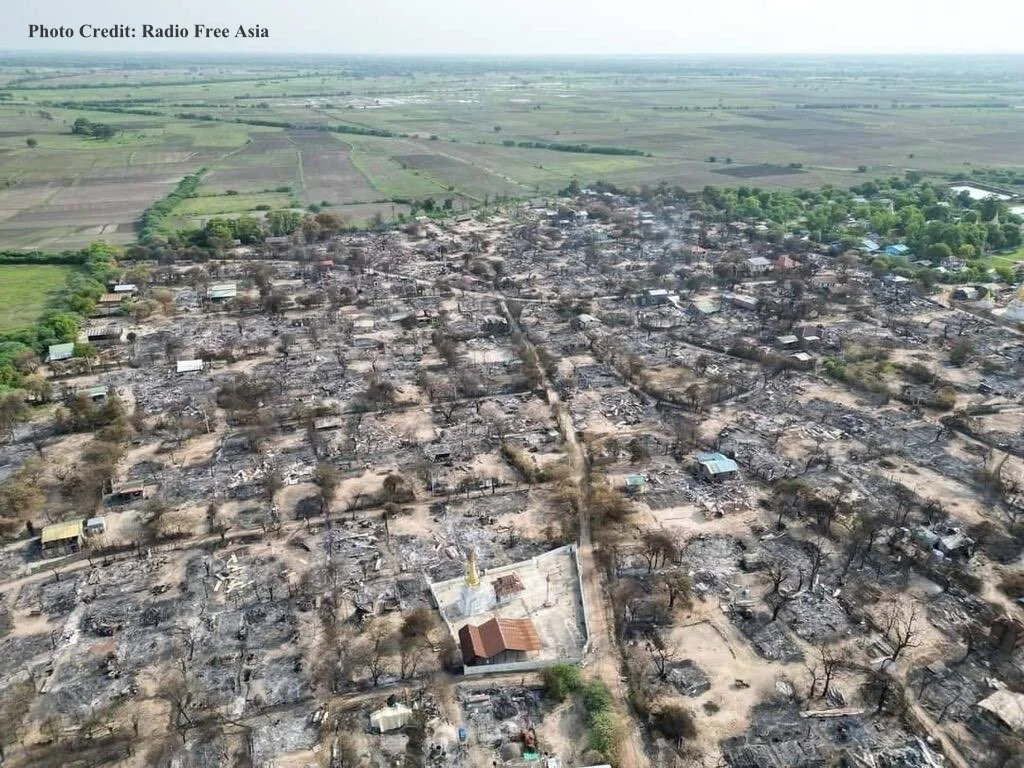

When Villages Turn to Ash
Nearly three weeks after Kyi Gone Village was attacked, what remains is a landscape of ash.
According to our team leader on the ground, homes that once stood in the eastern and western sections of the village are gone, not lost to accidental fire or chance spread, but deliberately burned in separate, targeted acts. The eastern and western villages are located apart from one another, yet both were intentionally set alight. A local monk estimates that nearly two villages have now been completely destroyed.
Beginning on November 28, military forces entered Kyi Gone Village and surrounding areas, setting up camp for nearly a week. There were no clashes with local defense groups. As troops arrived, villagers fled in large numbers, some hiding in fields, others seeking refuge in nearby monasteries.
What followed was devastation.
On the evening of December 5, soldiers began burning homes. At least 24 houses were destroyed that night alone. Civilians and monks were reportedly forced to clear landmines from roads. One civilian was shot and killed. The village monastery, often the last refuge in times of crisis was looted entirely. Rice, oil, salt, computers, refrigerators, and essential supplies were taken away by truck.
The attacks did not stop there.
By December 8, local contacts confirmed that both the western and eastern villages had been burned, leaving families scattered, displaced, and unable to organize aid for themselves. Some had already survived previous village burnings and were forced to flee yet again.
Where People Are Now
Around twenty days after the attacks, displaced villagers were formally evacuated from Kyi Gone. They left behind what little remained.
Today, families are sheltering across several monastic and temporary camps in the surrounding township. Better Burma has been in direct contact with local monks who are providing shelter and daily care.
At Magyidaw Vinkhaya Monastery, located in an urban quarter, the abbot reported that:
Around 400 families arrived beginning November 30
By mid-December, numbers fluctuated as some families moved onward
As of now, approximately 300 families remain sheltering there
The abbot described two main groups of displaced people:
Families who fled early and were able to bring some belongings
Families and monks who fled with nothing, some monks escaped wearing only the robes on their bodies
With winter setting in, the monastery urgently sought blankets and warm clothing upon their arrival. Local donors and supporters from other areas were able to help provide blankets and jackets. The monastery continues to provide three meals a day, but food supplies, particularly rice and cooking oil are now the most critical need.
Additional displaced families are sheltering at:
Ta-oo Monastery (30–40 families)
Aungmyae Tharzan Monastery (30–40 families)
A cardboard factory on the outskirts of town (around 100 families)
Bodhi Tawya Monastery in a neighboring village (around 100 families)
Our Humanitarian Response Plan
To support these displaced communities safely and effectively, Better Burma will distribute emergency humanitarian funds in three coordinated divisions, working directly with trusted monastic leaders:
Township Sangha Nāyaka Chair Monk
Funds will support food distribution for families sheltering in two urban monasteries.
Magyidaw Vinkhaya Monastery
The largest portion of aid will go here, supporting food supplies for the roughly 300 families currently sheltering at the monastery. We will also request assistance in arranging robes for displaced monks.
Bodhi Tawya Monastery
Funds will support food assistance for families sheltering in this neighboring village.
We will coordinate with the Township Sangha Nāyaka Committee to ensure that aid also reaches smaller camps and overlooked groups.
We will continue to share updates as distributions take place.
Thank you to everyone who has stood with the people of Kyi Gone and surrounding villages. Your support allows us to respond when communities are burned, looted, and left with nothing.